29 Jun 2026 · 91Leads CRM
How to Build a Sales Pipeline That Actually Helps You Close More Deals
A well-structured sales pipeline helps businesses manage every enquiry from the first interaction to the final sale. Learn how to build a pipeline that keeps your team organized, improves follow-ups, and helps convert more leads into customers.
"Raj bhai, leads toh bahut aa rahi hain... par sales utni kyun nahi badh rahi?"
I hear this question quite often.
And honestly, most people expect a complicated answer.
They think maybe Facebook Ads aren't working.
Maybe Google Ads need a bigger budget.
Maybe the sales team isn't good enough.
But after talking to hundreds of business owners, I've realized something.
Most businesses don't have a lead problem.
They have a process problem.
Let me explain.
Monday Morning... A Story You'll Probably Relate To
It's 9:45 AM.
The sales team has just settled in.
One executive walks over and says,
"Sir, kal website se ek enquiry aayi thi. Uska kya hua?"
Another person replies,
"Maine toh quotation bhej diya tha."
Someone else joins the conversation.
"Customer ne mujhe bola tha Friday ko call karna... kisi ne Lead follow-up kiya?"
Now everyone starts searching.
WhatsApp opens.
Excel sheet opens.
Someone checks Gmail.
Five minutes later...
Nobody knows where that customer actually is.
Aur sabse badi baat?
The customer is probably talking to your competitor by now.
If this sounds familiar, don't worry.
You're not the only business facing this.
So... What Exactly Is a Sales Pipeline?
Forget the textbook definition.
A sales pipeline is nothing more than a roadmap.
It tells your team one simple thing.
"What's the next step for this customer?"
That's it.
Without a pipeline, every lead feels random.
With one, every lead has a direction.
Step 1 – Every Lead Deserves Attention
It doesn't matter whether the enquiry comes from your website, Facebook Ads, Google Ads, WhatsApp, Justdial or a referral.
Every lead starts at the same place.
Someone has shown interest.
That's valuable.
One mistake I see businesses make is treating some leads as "important" and others as "I'll call later."
Truth is, you don't know which enquiry is going to become your biggest customer.
Step 2 – Respond Before Interest Disappears
Think about your own behaviour.
When you're looking for something online, do you fill one enquiry form?
Probably not.
You contact three or four companies.
The first one that responds usually gets your attention.
Customers behave exactly the same way.
We've seen businesses lose good opportunities simply because they replied the next morning instead of the next fifteen minutes.
Kabhi kabhi speed hi biggest advantage hoti hai.
Step 3 – Stop Talking. Start Listening.
One thing I've noticed during sales calls is this.
Many people start selling within the first two minutes.
They explain every feature.
Every price.
Every offer.
Without even understanding what the customer actually needs.
Ask questions first.
Why are they looking for a solution?
What's bothering them?
What's their budget?
Sometimes customers don't need a long presentation.
They just need someone who listens.
Step 4 – Keep Every Conversation in One Place
Have you ever called a customer and completely forgotten what you discussed last week?
We've all done it.
It's awkward.
The customer immediately feels like they're talking to someone who isn't prepared.
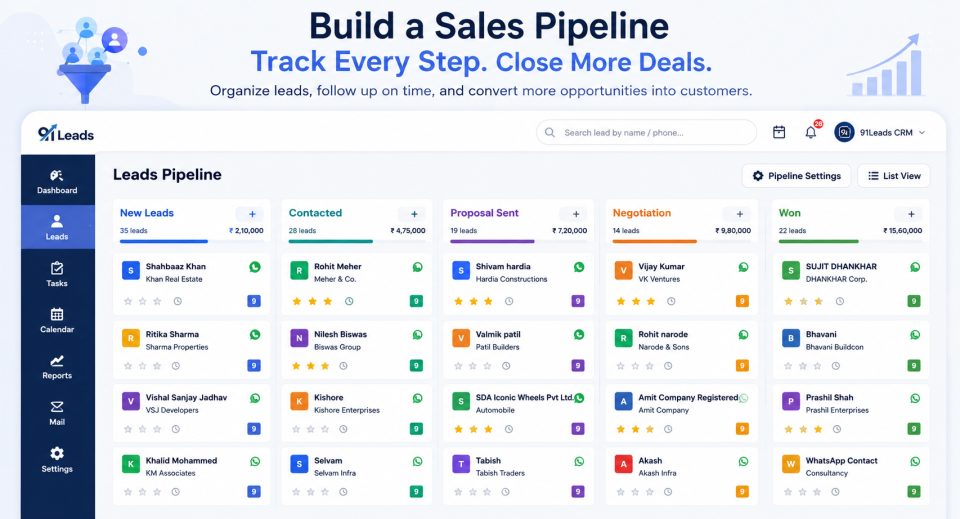
Now imagine opening the customer's profile and seeing every previous call, note, quotation and follow-up in one timeline.
Suddenly the conversation feels natural.
That's exactly what a good sales pipeline should support.
Step 5 – Most Deals Aren't Lost...
They're Forgotten.
This is probably the biggest lesson we've learned.
Customers rarely say,
"I'm never buying from you."
Instead, life gets busy.
They travel.
Meetings happen.
Family commitments take over.
Aur hum assume kar lete hain ki customer interested hi nahi tha.
Many deals come back after one simple CRM follow-up.
That's why reminders matter.
Not because your team is careless.
Because everyone is human.
Step 6 – Know When to Let Go
Not every lead is worth chasing forever.
And that's okay.
Some customers aren't ready.
Some don't have the budget.
Some simply choose another option.
A healthy sales pipeline helps you recognize this.
Close the opportunity.
Learn from it.
Move forward.
Sales isn't about winning every deal.
It's about managing every opportunity professionally.
Step 7 – Everyone Should See the Same Picture
One thing that creates unnecessary confusion is when every salesperson keeps their own records.
One has WhatsApp chats.
Another has Excel.
Someone else remembers everything "by heart."
It works...
Until that person goes on leave.
Or resigns.
Then suddenly nobody knows what's happening.
A pipeline shouldn't live inside someone's memory.
It should live inside your business.
Step 8 – Don't Guess. Measure.
One question I ask almost every business owner is,
"How many follow-ups are pending today?"
Very few can answer immediately.
Not because they don't care.
Because the information isn't easily available.
Once your pipeline is organised, questions like these become easy to answer. A CRM dashboard gives business owners complete visibility into leads, follow-ups, and conversions without waiting for Excel reports.
How many new enquiries came today?
How many proposals are waiting?
Which salesperson needs support?
No guessing.
Just clarity.
Step 9 – Improve the Process Every Month
Here's something successful sales teams do differently.
They don't just celebrate closed deals.
They also review lost ones.
Why did the customer say no?
Was the response slow?
Was pricing the issue?
Did nobody follow up?
Every lost deal teaches something.
And those lessons make your pipeline stronger month after month.
Step 10 – Make Growth Feel Less Stressful
One customer told us something I'll never forget.
"Raj bhai, pehle business grow ho raha tha... lekin stress bhi utna hi badh raha tha."
A few months after organising their sales pipeline, he said,
"Ab leads zyada hain, team bhi busy hai... but sab control mein lagta hai."
That's probably the biggest benefit.
A pipeline doesn't magically increase sales.
It gives your team confidence.
Everyone knows what needs to happen next.
Customers receive timely responses.
Managers get visibility.
Aur office mein roz ye question sunai nahi deta...
"Sir... woh lead gayi kahan?"
How 91Leads CRM Makes It Easier
Building a sales pipeline on paper is easy.
Following it every single day is the hard part.
That's where 91Leads CRM Software helps.
Whether your enquiries come from Facebook Ads, Google Ads, your website, WhatsApp, IndiaMART, Justdial or referrals, every lead enters one system.
You can assign it instantly.
Track every conversation.
Set follow-up reminders.
Monitor each stage of the pipeline.
And most importantly, make sure no genuine opportunity slips through the cracks simply because someone forgot to call.
Final Thoughts
If there's one thing I'd like you to remember from this article, it's this:
You don't always need more leads.
Sometimes, you simply need a better way to manage the ones you already have.
A good sales pipeline won't make customers buy from you. If you'd like to see how a structured sales pipeline works in practice, you can start a Free CRM Trial or explore our Pricing Plans to find the right solution for your business.
But it will make sure every enquiry gets the attention it deserves.
And in today's competitive market, that alone can make a huge difference.