07 Jul 2026 · 91Leads CRM
Automotive Lead Management System: A Complete Guide for Car Dealerships
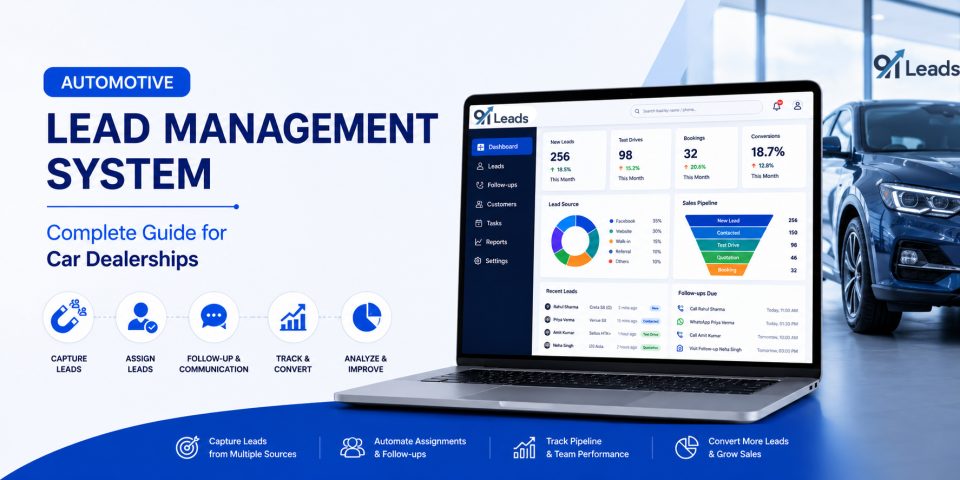
Discover how an Automotive Lead Management System helps dealerships manage enquiries from multiple sources, automate lead assignments, track follow-ups, and improve sales efficiency from the first enquiry to vehicle delivery.
The Customer Was Ready to Buy...
But Nobody Called Back.
If you've worked in a car dealership, this story will probably sound familiar.
A customer visits the showroom on Saturday afternoon.
He likes the car.
Takes a test drive.
Asks for the finance quotation.
Before leaving, he says,
"I'll talk to my family and get back by Monday."
Monday comes.
The salesperson gets busy with new walk-in customers.
Tuesday goes by.
Someone remembers the customer on Wednesday, but by then it's already too late.
The customer has booked the same car somewhere else.
Was the price the problem?
Not always.
Sometimes, the only difference is that another dealership followed up first.
That's exactly why dealerships are investing in an Automotive Lead Management System.
It's not about collecting more enquiries.
It's about making sure every genuine buyer gets the attention they deserve.
What is an Automotive Lead Management System?
Let's keep it simple.
An Automotive Lead Management System is software that helps dealerships manage every customer enquiry from the first interaction until the vehicle is delivered.
Instead of keeping customer details in Excel sheets, notebooks, WhatsApp chats, or individual sales executives' phones, every lead is stored in one place.
Whether an enquiry comes from Facebook Ads, Google Ads, CarDekho, CarWale, your website, WhatsApp, or a walk-in customer, the system keeps everything organised.
For the sales manager, that means fewer missed opportunities.
For the customer, it means a smoother buying experience.
Why Excel Stops Working After a Certain Point
To be fair, almost every dealership starts with Excel.
It works when there are only a handful of enquiries each week.
But things change quickly.
Suddenly, you're getting:
- Facebook enquiries
- Google Ads leads
- Website forms
- Walk-in visitors
- WhatsApp messages
- Phone calls
- Referral customers
Now imagine trying to remember who requested a test drive, who wanted a finance quotation, and who asked for an exchange value.
This is where things begin to slip.
Not because your team isn't working hard.
Because people simply can't remember hundreds of conversations.
What Happens Without a Proper Lead Management System?
One missed follow-up.
One forgotten quotation.
One customer assigned to the wrong salesperson.
These small mistakes happen every day.
Eventually, they become lost sales.
An Automotive Lead Management System reduces these problems by giving everyone a clear process to follow.
No guessing.
No searching old chats.
No wondering who last spoke to the customer.
The Journey of Every Car Buyer
Every customer follows a journey.
It rarely ends after the first enquiry.
It usually looks something like this.
New Enquiry
      ↓
Lead Assigned
      ↓
First Call
      ↓
Showroom Visit
      ↓
Test Drive
      ↓
Quotation Shared
      ↓
Finance Discussion
      ↓
Booking
      ↓
Vehicle Delivery
      ↓
Service Reminder
A good lead management system tracks every stage automatically.
Features Every Automotive Lead Management System Should Have
1. Lead Capture from Every Source
Customers don't use just one platform anymore.
Your dealership might receive enquiries from:
- Facebook Ads
- Google Ads
- CarDekho
- CarWale
- Website Forms
- Walk-ins
- Phone Calls
- Referrals
A good system brings all of these into one dashboard.
Imagine receiving 60 enquiries on a festive weekend.
Without automation, someone has to manually distribute them.
That takes time.
Sometimes two executives call the same customer.
Sometimes nobody calls.
Automatic lead assignment solves that problem.
People don't forget intentionally.
They simply become busy.
A reminder can be the difference between winning and losing a customer.
4. Test Drive Tracking
Booking a test drive is only one step.
After the drive, the dealership should know:
- Was the customer interested?
- Is finance required?
- Was another variant discussed?
- Is another follow-up needed?
5. Sales Pipeline
Managers should know instantly:
- Which deals are progressing?
- Which leads are stuck?
- Which bookings are expected this week?
Without opening Excel.
Without asking every salesperson individually.
6. Team Activity Monitoring
One question every dealership owner asks is,
"Are follow-ups actually happening?"
A lead management system answers that.
Managers can see:
- Calls made
- Follow-ups completed
- Pending enquiries
- Team performance
Everything from one dashboard.
7. WhatsApp and Meta Integration
Many customers now prefer WhatsApp over phone calls.
Some ask for quotations.
Others send documents.
A modern Automotive Lead Management System should integrate with WhatsApp and Meta lead forms so every conversation stays linked to the customer profile.
Common Mistakes Dealerships Make
One thing I've noticed is that dealerships often focus on generating more leads.
The real issue is usually somewhere else.
They're already getting enquiries.
The problem is managing them consistently.
Buying more advertisements won't fix a broken follow-up process.
A better system often will.
How 91Leads Helps Dealerships
At 91Leads CRM, we've designed our platform around the way dealership teams actually work.
Instead of forcing businesses to change their process, the Custom CRM Software adapts to it.
You can:
- Capture enquiries from multiple sources
- Assign leads automatically
- Track every follow-up
- Manage your sales pipeline
- Monitor team activity
- Generate reports
- Keep customer conversations organised
Whether you're running a single showroom or multiple branches, every enquiry stays visible from the first call to vehicle delivery.
Final Thoughts
At the end of the day, an Automotive Lead Management System doesn't sell cars.
Your sales team does.
But it gives them something equally valuable.
A clear process.
Customers don't usually disappear because they weren't interested.
Sometimes they disappear because nobody remembered to call them back.
And that's one of the easiest problems a dealership can solve.